Welcome to the HABITAT NETWORK website Connecting people and habitat
Last updated March 2024
The Hunters Hill small bird habitat corridor has received funding from the NSW Governments Coastal and Estuary Management Program for
Strengthening Biodiversity Corridors along the Lower Lane Cove and Parramatta Estuaries (2022 to 2024). Read more about this project extension
here.
As part of this project we have helped produce a video about the biodiversity of Hunters Hill
find link here.
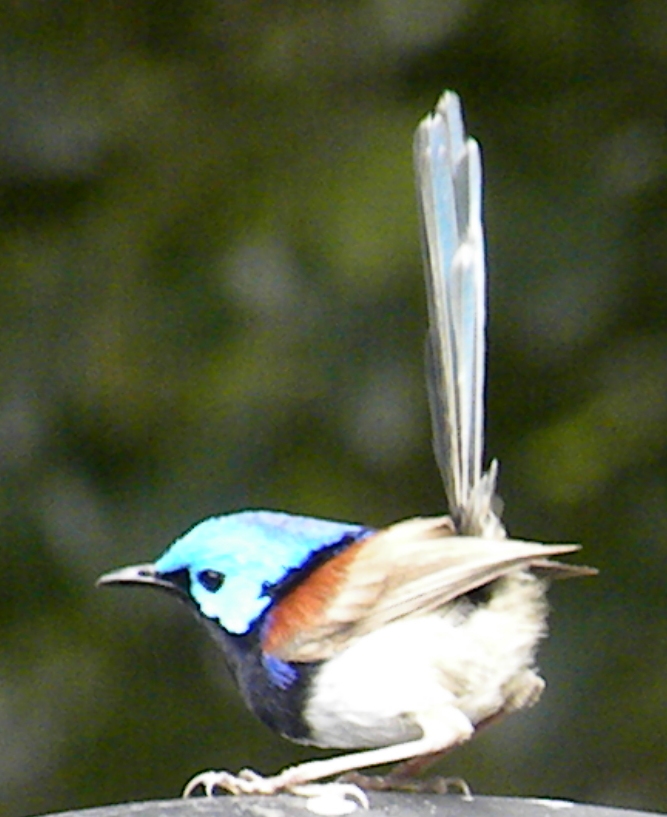
We are also very excited to report that on 17 February 2024 we saw a female Varietgated fairywren in the garden at The Habitat - it was with a 2nd tiny bird but we didnt get a clear view of it. It may have been another Variegated fairywren or a White-browed scrubwren - see
a short video of this wren here.
Our community native plant nursery and community food garden
"The Habitat"
is open every
Wednesday and Saturday 10 am to 4 pm. If you would like to buy some native plants or food plants for your garden
or to discuss habitat, native plants, food plants or weeds do come and visit. Find us at Santa Rosa Park, 251 Quarry Road, Ryde.
The Habitat Network is a network of people conserving, reconnecting and creating habitat for the benefit of our native
plants and animals enriching our environment and our community.
Our aim is to reconnect isolated populations of small native birds, pollinators and other native animals
which through loss of habitat are rapidly disappearing from our urban and rural environments.
By including small pockets of native plants in our gardens, we can provide wildlife habitat. Connect to
your neighbours and encourage them to include a habitat area in their garden and you have a start of a corridor.
Why not get your whole street involved?
We can also work with our local Councils, bushcare and landcare groups to conserve our bushland and habitat areas,
extend our bushland edges (specifically for habitat) and plant habitat havens (protective bushy islands)
to enhance or create native corridors.
If you are in a bushcare or landcare group or a street habitat / community garden group please think about how to connect your
patch to the nearest bushland area to extend or create a habitat corridor. Let us know what you are doing and we will
help to promote your project. Wouldn't it be fantastic if we as volunteers could help
connect habitat all the way across our city, town or region. As our population increases
these connections will be vital.
The Habitat Network is a Restoring Natural Capital project being run by International Environmental
Weed Foundation (IEWF). IEWF is a not-for-profit organisation run entirely by volunteers. Visit our websites:
IEWF has a representative on the Greater Sydney Landcare committee and Landcare NSW Council.
We encourge all bushcare and landcare groups in the Greater Sydney area to join the Greater Sydney Landcare.
Please find out more by visiting
www.greatersydneylandcare.org
Innovation Award 2011, Landcare NSW Group Champion 2017, Partnership Award 2021
In May 2011 the Habitat Network won both the Innovation Award (joint 1st) and a Highly Commended for
Urban Landcare. These were awarded by Sydney Metropolitan Catchment Management Authority as part of their 2011 Regional Awards.
Well done to all of our Habitat Network members and to all who help with this project.
Please see our "Activity photos" page above and read about other winners n the SMCMA
2011 Winter Mambara Issue 31 (pdf 1.15MB).
Also see the video about the Habitat Network produced by
SMCMA
and look for the other winner's there too.
In 2017 Habitat Network was a Group Champion at the Landcare NSW Awards - October 2017. This award was for our work in establishing and running
The Habitat and for the work of our volunteers with the Shrimptons Creek Small Bird Habitat Corridor which delivered habitat havens and connections
planted along aproximately 2.5 km of creekline.
In May 2021 Habitat Network and Hunters Hill Council won a Partnerships in Landcare Award for our ongoing
Hunters Hill Small Bird Habitat Project which now extends a least 9 km.
top
Click here
to:
* find out why we want to re-create lost habitat,
* learn how we can create habitat,
* see our habitat plant photos and information pages to discover what you may like to grow, and
* read our Habitat Network member's stories and see their photos.
We have a number of
Resources including diagrams, information sheets and brochures
which we encourage you to download and use. There are also simple to use web based resources which are there for you to use.
We have some wonderful people helping us survey, monitor and
build the foundations for expanding this project. It is invaluable that we collect information about what
is happening. You can help us collect this information by recording what you see in your garden or in nearby bushland.
We would also like to hear about street trees and plantings that you see working as habitat corridors.
Please follow this link to read about the
Science and to find our "Animals in my Backyard Survey" form and how you can help us.
The Habitat is being run by the community in partnership with City of Ryde
at Santa Rosa Park, 251 Quarry Road, Ryde.
If you would like to learn something new, meet new friends, share your knowledge and do something which will help our local environment
come along to The Habitat. Volunteers are always welcome - visit us between 10am and 4pm any Wednesday or Saturday.
Check out The Habitat - and find links to other
community nurseries, community gardens and related sites
HERE.
If you would like to be involved please email info@iewf.org
or simply drop in for a visit.
Check out Marianne Cannon's "Real World Gardener" program on local Sydney radio 2RRR 88.5fm Wed 5pm and Sat 12 noon. You
can also listen to interviews with local experts:
http://realworldgardener.blogspot.com
Check out our poster on how to plant a small bird habitat haven in your garden creating a valuable connection between habitat areas
A3 size and
A4 size.
Posters and other materials are available on our Resources page.
The Hunters Hill small bird habitat corridor has received funding from the NSW Governments Coastal and Estuary Management Program for
Strengthening Biodiversity Corridors along the Lower Lane Cove and Parramatta Estuaries (2022 to 2024). Read more about this project extension
here.